
SEQ Elevate publishes Key Research Findings and a Learning Model Framework about Social and Emotional Skills Development and Employability of NEET youth
The SEQ Elevate – Skills for the Future project proudly announces the publication of two major project deliverables: the Transnational Research Report (Deliverable 2.1) and the SEQ Learning Model Framework (Deliverable 2.3), under Work Package/WP 2. These key outputs mark a significant milestone in the project’s implementation, laying the foundation for the next phases of development, including the design of the project’s digital learning tool and upcoming pilot activities.
Beyond Technical Skills: Research Insights on NEET Youth Employability
The SEQ Elevate Transnational Research Report presents the consolidated findings of the project’s research activities carried out across Greece, Cyprus, Belgium, and Germany. Combining NEET (Not in Education, Employment or Training) youth surveys, stakeholder consultations, focus groups, and an EU-level expert discussion, the research aimed to identify and benchmark the social and emotional skills needs of NEET youth alongside labour market expectations and emerging policy directions. The findings provide the scientific foundation for the development of the SEQ Learning Model and Validation Framework, ensuring that future training activities respond directly to the real needs of learners and employers.
The research activities engaged:
- 69 NEET youth respondents
- 36 stakeholder representatives
- 16 focus group participants
- 9 European-level experts
The findings reveal that while technical and digital skills are often prioritised in training programmes, social and emotional skills remain one of the most significant employability gaps affecting NEET youth. Across countries, participants consistently highlighted challenges related to confidence, stress management, communication, teamwork, behavioural readiness, and adaptability in professional environments.
Key insights include:
- Confidence gaps often prevent young people from taking initiative in professional and social settings.
- Employers increasingly prioritise observable competences and interpersonal skills over theoretical knowledge alone.
- Stakeholders identified social and emotional skills gaps as more critical than technical skill gaps at entry level.
- NEET youth strongly prefer short, practical, and scenario-based learning experiences over theory-heavy instruction.
- Long-term disengaged NEETs require confidence-first activation pathways, while migrants and early school leavers benefit from adapted and flexible learning formats.
- The findings show a growing interest in flexible and practice-based recognition systems that support employability and lifelong learning.
The research outcomes underline the need for a modular, practice-based, and validation-oriented learning model aligned with EU priorities on micro-credentials, lifelong learning, and non-formal education. Recommendations include the use of skill badges linked to specific competence clusters, scenario-based assessment tasks, and self-validation tools such as the SEQ Comp Cards, helping make skills recognition more transparent, employer-readable, and relevant for recruitment and workplace integration
Access the report in the following link:
https://seqelevate.eu/d2-1_transnational-research-report/
Available in English, German and Greek
Introducing the SEQ Learning Model Framework
In direct response to the research findings, the SEQ Learning Model Framework (Deliverable 2.3 under WP2) introduces a structured and evidence-based methodology designed to support NEET youth in developing, practising, and validating social and emotional skills within the social economy context. The framework transforms social and emotional skills from abstract concepts into practical, observable competences that can be applied in real-life employability settings.
At the core of the framework is a strong learning-by-doing approach, prioritising scenario-based learning, simulations, role-play activities, and applied exercises over theory-heavy instruction. The model also adopts a confidence-first approach, recognising that confidence gaps, behavioural readiness, and stress management are often major barriers preventing young people from actively engaging in learning and employment pathways.
The framework is organised around eight practical skill clusters, including:
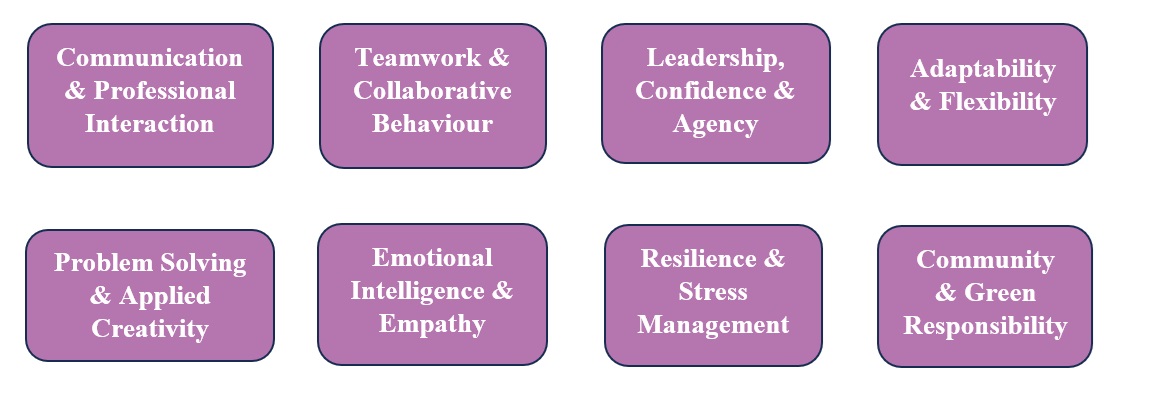 Learning is delivered through flexible micro-learning units linked to behavioural indicators, practical assessment activities, and digital badges, ensuring that competences are visible, transferable, and employer-readable.
The framework also introduces the concept of the SEQ Comp Cards, a complementary self-validation and reflection tool designed to support learner agency and skills recognition. The Cards will enable learners to monitor their progress, compare self-perception with facilitator feedback, and collect evidence of competence development across learning modules. The SEQ Comp Cards will be further integrated and showcased within the project’s upcoming digital learning tool, currently under development.
In addition, the framework establishes a structured learning pathway for each learning unit, gradually guiding learners from contextual understanding to practical skill application and validation. Through guided simulations, applied scenarios, reflection activities, and micro-assessments, learners progressively build confidence while demonstrating competences in realistic environments.
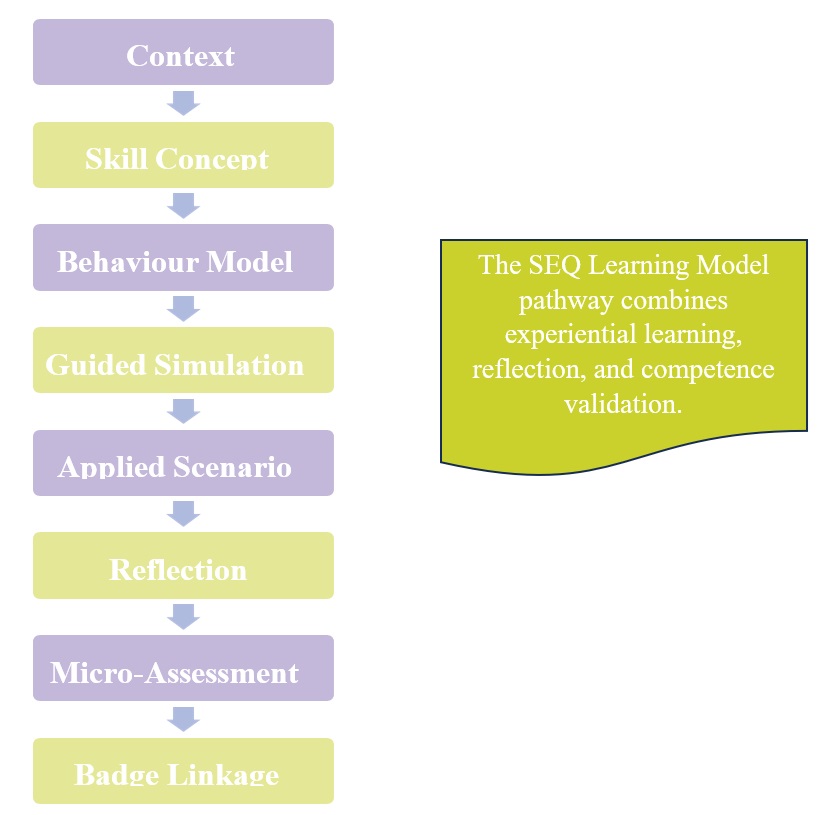
Designed as a modular, validation-oriented, and multilingual framework available in English, German, and Greek, the SEQ Learning Model Framework will serve as the methodological foundation for the project’s upcoming gamified digital learning tool (currently under development), including micro-learning units for informal learning tailored to the needs of NEET youth.
Access the report in the following link:
https://seqelevate.eu/the-seq-learning-model-framework-deliverable-2-3-under-wp2/
Available in English, German and Greek
About SEQ Elevate
The SEQ Elevate: Skills for the Future project is an EU co-funded, Social Innovation (SI+) Initiative project, with a duration of 24 months (07.2024-07.2027). It brings together four partners: PRO Arbeit (project coordinator from Germany), the University of Macedonia (Greece), Diesis Network (Belgium), and SYNTHESIS Center for Research and Education (Cyprus). Its aim is to support vulnerable young people not in employment, education, or training (NEETs) in re-engaging in learning and improving their employability in social economy sector.
Our mission is to re-engage vulnerable youth and NEETs in learning that matters, developing their social and emotional skills essential for success in life and work. Through innovative, co-designed learning tools, interactive micro-units, and dynamic SEQ local Living Labs, we create opportunities for self-discovery, collaboration, and meaningful participation of NEET youth in society.
Project number: ESF-SI-2023-SKILLS-01-0065
📩Contact us for more information: pm8@synthesis-center.org
Stay connected with SEQ Elevate!
- Facebook: SEQ Elevate Skills for the Future
- LinkedIn: SEQ Elevate Skills for the Future
- Instagram: seq_elevate